
What was once dismissed as routine shoplifting has evolved into coordinated, professionalized theft carried out by criminal networks that treat your store as a supply chain. These groups steal high-value, easy-to-resell merchandise in volume, move it through “fences” and online marketplaces, and reinvest the proceeds into more theft. For store owners and loss prevention leaders, the question is no longer whether to take organized retail crime seriously, but how to build security measures and on-site security services that actually hold up against it.
The most effective answer is rarely a single product or a single retail security guard. It’s a layered approach in which deterrence, detection, response, and recovery each cover the gaps the others leave behind. This guide walks through that layered model and the specific security measures that make it work.
What Organized Retail Crime Actually Is
Understanding the threat is the first step toward defending against it. Organized retail crime, often shortened to ORC, refers to the large-scale theft of merchandise by groups working together with the intent to resell what they steal for profit. It is fundamentally different from a lone shoplifter taking an item for personal use.
A typical ORC operation involves several roles. “Boosters” are the people who physically remove product from shelves, frequently using booster bags lined to defeat anti-theft sensors, distraction tactics, or coordinated sweeps that clear an entire display in seconds. The stolen goods then move to a “fence,” who buys merchandise at a fraction of its retail value and resells it through flea markets, storefronts, or increasingly through online marketplaces in a practice known as e-fencing. Because the goods are converted to cash quickly and the network is decentralized, these crimes are notoriously difficult to trace back to their source.
The scale of the problem is significant and growing. The National Retail Federation, in partnership with the Loss Prevention Research Council, reported in late 2025 that retailers saw an 18% increase in the average number of shoplifting incidents in 2024 compared with 2023, while threats or acts of violence during theft events rose 17% over the same period. Earlier NRF research estimated total shrink, the industry term for inventory losses from theft, error, and fraud, at roughly $112 billion in a single year. The clear takeaway is that ORC is becoming both more frequent and more dangerous, which is exactly why a reactive, single-measure approach falls short.
Why a Layered Defense Beats Any Single Measure
It is tempting to look for one solution, install security cameras, post a retail security guard at the door, or lock up the most-stolen items and consider the problem solved. ORC crews, however, are adaptive. They case stores in advance, identify the single point of protection, and plan around it. A security camera with no one watching it becomes a passive recording device. A retail security guard at the front entrance does nothing for the stockroom exit. A locked display case simply pushes thieves toward the next aisle.
A layered, or “defense-in-depth,” strategy assumes any one measure can be defeated and stacks protections so that defeating one still leaves the criminal facing several more. Each layer does a different job: the outer layers discourage the attempt entirely, the middle layers catch what gets through, and the inner layers ensure that incidents are documented, interrupted, and ultimately resolved. Built correctly, the layers reinforce one another. The sections below break the model into four working layers.
Layer One: Visible Deterrence
The cheapest theft to deal with is the one that never happens. Deterrence works because ORC crews are making a business calculation. They target stores where the risk of being seen, stopped, or identified is low. Raising that perceived risk often sends them looking for an easier target.
The single most effective deterrent is a visible, professional security presence. A uniformed security guard stationed near entrances and high-theft departments signals to a casing crew that someone is paying attention and prepared to respond. Trained retail security guards do more than stand watch; they recognize the behavioral cues of organized theft, groups entering separately and converging, individuals carrying empty bags, repeated visits to scope a layout, and can intervene before a sweep begins.
Store design reinforces the human element. Clear sightlines, well-lit aisles, controlled entry and exit points, and strategic product placement that keeps the highest-value items within view of staff all reduce opportunity. Greeters at the door, even unarmed, create a moment of human contact that deters anonymous theft. The goal of this layer is simple: make your location feel watched and managed rather than open and unmonitored.
Layer Two: Surveillance and Detection Technology
When deterrence doesn’t stop an attempt, detection ensures it doesn’t go unseen. Technology is the workhorse of this layer, and modern systems do far more than passively record footage for later review.
A well-designed CCTV system provides comprehensive coverage of sales floors, entrances, stockrooms, and parking areas, eliminating the blind spots that crews exploit. Security camera placement matters as much as quality. Coverage should be planned around traffic flow and known high-theft zones rather than scattered for general surveillance. Footage serves two purposes: it supports real-time intervention, and it becomes the evidence that turns an anonymous theft into a prosecutable case.
The real advantage comes from active monitoring. Security cameras watched by trained professionals through live camera monitoring shift surveillance from a forensic tool into a response trigger. Operators can spot a developing sweep, alert on-site personnel, and document the event as it unfolds. Layered on top of security cameras, electronic article surveillance, the sensor tags and gate alarms at store exits, adds a physical detection point, while anti-theft devices such as locking displays, cable locks, and spider wraps slow boosters down enough to make a clean grab impractical. Together, these tools cover the gap between “someone is trying to steal” and “someone knows about it.”
Layer Three: Trained Personnel and Active Response
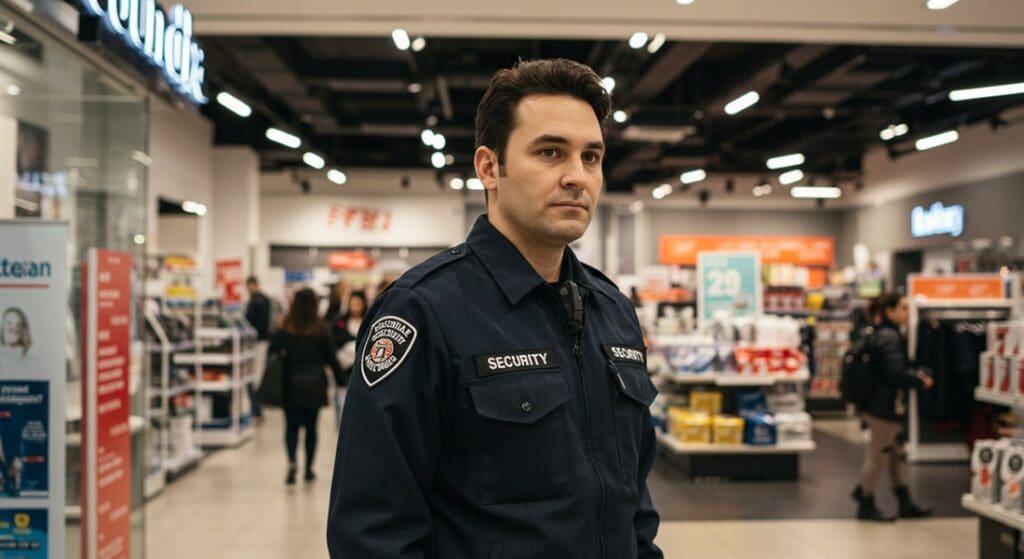
Detection is only valuable if someone acts on it. The response layer is where security personnel turn information into intervention, and it is the layer that most distinguishes a serious program from a box-checking one.
Dedicated loss prevention specialists are trained specifically to identify, observe, and address theft in a way that protects merchandise without escalating danger to staff or customers. This is a critical distinction in the ORC era. With violence during theft events rising, the instinct to physically confront a fleeing crew can put employees and bystanders at serious risk. Professional loss prevention emphasizes documentation, controlled intervention, and de-escalation, protecting people first and recovering property within safe limits.
A broader security guard program extends that capability across the property. Security guards trained in retail environments coordinate with store management, maintain a deterrent presence, and act as the first responders to an incident in progress. When an alarm or sensor is triggered after hours or in an unstaffed area, alarm response services ensure that a trigger is met with an actual human assessment rather than an ignored notification. The defining feature of this layer is speed and judgment: the ability to respond appropriately, in the moment, without creating a more dangerous situation.
Layer Four: Coordination, Investigation, and Recovery
The final layer addresses what happens after an incident, and it is the layer that actually disrupts organized crime rather than just deflecting it to the store down the street. Because ORC operates as a network, isolated incidents look minor until they are connected. A coordinated approach links them.
This means treating documentation as intelligence. Detailed incident reports, clear security camera footage, descriptions of suspects and vehicles, and records of stolen merchandise all feed investigations that can identify repeat crews and the fences they sell to. Many regions now run organized retail crime task forces and information-sharing networks that connect retailers with one another and with law enforcement, allowing a pattern at one store to inform protection at the next.
Most retailers don’t have the in-house expertise to build this layer alone, which is where professional security consulting becomes valuable. A consultant assesses your specific vulnerabilities, designs reporting protocols that produce usable evidence, and establishes the relationships with local authorities that make recovery and prosecution possible. This layer transforms your store from a passive victim into an active participant in dismantling the networks targeting it.
Tailoring Your Program to Your Store
The four layers apply broadly, but the right mix depends on your environment. Organized crews target merchandise that is easy to grab and easy to resell, so apparel, electronics, beauty products, and brand-name goods draw the most attention. The format of your store shapes the threat as well.
Grocery and supermarket operations face high foot traffic, multiple exits, and frequent theft of meat, baby formula, and over-the-counter health products. For these, surveillance coverage of multiple exit points and a visible floor presence carry extra weight. Convenience stores, often staffed by a single employee during off hours, are uniquely exposed and benefit most from strong deterrence, monitored security cameras, and reliable alarm response. Specialty and big-box retailers carrying high-value inventory typically need the full stack, with particular emphasis on detection technology and trained loss prevention.
The point is that an effective program is assessed and designed, not bought off a shelf. The same four layers are present everywhere; the weighting changes with the risk.
Building Your Defense With a Professional Partner
Organized retail crime is a coordinated, adaptive threat, and the businesses that withstand it are the ones that respond with an equally coordinated strategy. No single security camera, lock, or retail security guard solves the problem. Layered deterrence, detection, response, and recovery, working together and tuned to your specific store, is what actually protects your inventory, your employees, and your customers.
For more than three decades, ALK Global Security has helped national retailers and local businesses build exactly that kind of defense. Our retail security programs combine experienced, professionally trained personnel with modern surveillance technology and the operational know-how to tie it all together. We work with some of the biggest names in retail because we treat each location as its own problem to solve rather than applying a one-size-fits-all template.
If organized retail crime is cutting into your margins or putting your team at risk, the most important step is an honest assessment of where your current protection has gaps. Request a quote and let our team design a layered security program with proven security measures built for the way your store actually operates.