
Dallas-Fort Worth keeps adding people and companies faster than almost anywhere else in the country. The U.S. Census Bureau estimates the metro added roughly 178,000 residents in a single year, bringing it to about 8.3 million people. And according to commercial real estate firm CBRE, DFW landed 11 interstate or international headquarters relocations in 2025, more than any other U.S. metro, and has captured more than 100 headquarters relocations since 2018.
Every one of those new offices, distribution centers, retail locations, and residential communities eventually faces the same question: who do we trust to protect it? Choosing the right Dallas security company keeps your business and consumers safe from potential threats.
That decision is harder than it looks. Dallas itself is getting safer on paper. The Dallas Police Department reported that violent crime fell about 12% in 2025, with murders, aggravated assaults, and robberies all declining citywide, and homicides dropped to 141, down 23% from the prior year, with robberies down 10% and aggravated assaults down 12%.
But the department is stretched: DPD is operating with about 3,286 officers, roughly 700 below the city’s target. For most businesses, that gap is exactly why private security exists, a uniformed deterrent and rapid on-site response that doesn’t depend on a thinly staffed patrol force.
The catch is that “security company” covers everyone from a one-person operation with a magnetic sign to a fully licensed, multi-state firm. This guide walks through the criteria that actually separate a capable Dallas security company from the rest, and the questions to ask before you sign.
Key Factors to Consider When Choosing a Security Company in Dallas
This guide walks through the criteria that actually separate a capable Dallas security company from the rest, and the questions to ask before you sign.
1. Confirm They’re Licensed Under Texas Law
This is the first filter, and it eliminates a surprising number of operators. In Texas, private security is regulated by the Texas Department of Public Safety Private Security Program under Texas Occupations Code Chapter 1702, which classifies and licenses security guard companies, security alarm systems companies, and security services contractors. A legitimate provider holds a current company license (not just individually licensed security guards) and can produce its license number on request.
Ask specifically whether the officers assigned to you will be armed or unarmed, because Texas treats them differently: unarmed personnel are non-commissioned officers, while armed personnel are commissioned officers with additional training and firearm-proficiency requirements. A reputable firm offering professional security guard services will match the commission level to your actual risk rather than defaulting to whatever is cheapest. If a vendor is vague about licensing, bonding, or whether their uniformed officers are properly credentialed, treat that as disqualifying.
2. Look for Genuine Local Knowledge of Dallas
Crime in Dallas is not evenly distributed, and a provider who treats the city as one undifferentiated map will misallocate your budget. The DPD’s own data shows results vary sharply by patrol division, industrial corridors face cargo theft and commercial burglary, while downtown and entertainment districts deal with foot-traffic and event-driven risk. A capable partner understands those distinctions and tailors coverage accordingly.
Local knowledge also means understanding Dallas’s event calendar, its concentration of corporate campuses, and the practical realities of response times across a sprawling metro. When you evaluate a firm, ask how its Dallas security services account for your specific submarket, a warehouse near a freight corridor needs a different plan than a Uptown office tower or a suburban retail center. Generic, copy-paste proposals are a sign the provider hasn’t done that homework.
3. Make Sure the Service Range Can Scale With You
Given how fast DFW companies grow, the security relationship you start today should be able to expand without forcing you to re-bid the whole contract. The strongest sign of a long-term partner is breadth: can they take you from a single overnight security guard to a full, multi-site program as you scale?
Look for a provider that offers mobile patrol for properties that don’t justify a stationary post, dedicated on-site security for fixed locations, and structured corporate security programs for organizations with executives, headquarters facilities, and complex access needs. A firm that only does one thing will either turn away your future business or subcontract it to someone you never vetted.
4. Evaluate Their Technology and How It Integrates
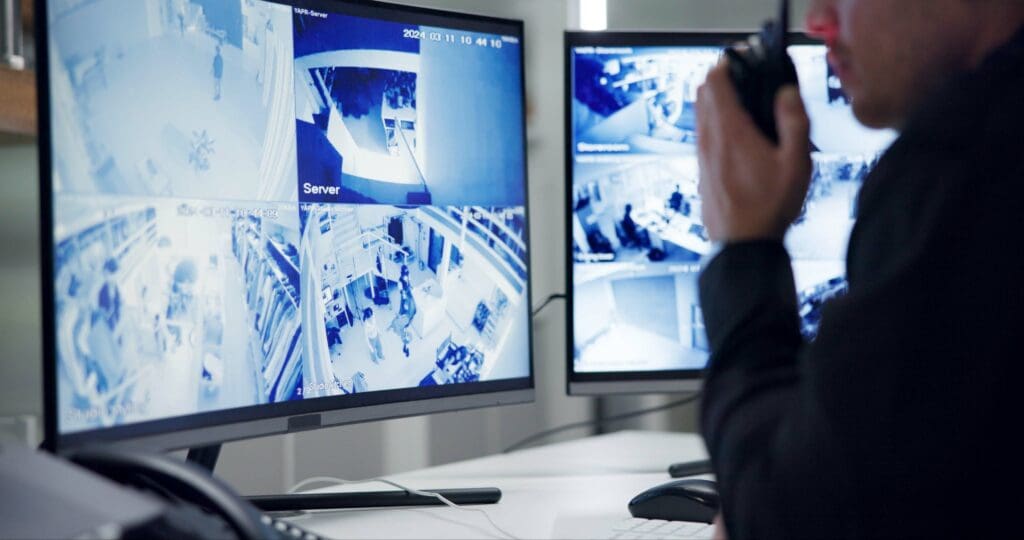
Modern security is guards plus systems, and the integration matters as much as the hardware. Dallas has leaned into security camera-based collaboration. The city’s Connect Dallas program lets businesses register private security cameras so police can access footage during investigations, which only helps if your system is actually built for it.
Ask how a prospective provider handles CCTV systems and ongoing security camera installation and monitoring. The right answer ties security cameras, security alarms, and live personnel into one coordinated response rather than selling you equipment that sits unwatched. Technology that no one is actively monitoring is evidence after the fact, not prevention.
5. Check for Industry-Specific Experience
The threats facing a hospital differ from those at a construction site, a retail store, or a private event, and experience in your vertical shortens the learning curve dramatically. While Dallas’s overall violent crime is down, business and commercial-property risks like retail theft and jobsite material loss remain persistent operational headaches.
A well-rounded Dallas firm should be able to point to relevant work across the sectors that matter to you. Loss prevention for retailers, hospital and healthcare security for medical facilities, construction site security for active builds, and event security for the conferences and gatherings Dallas hosts year-round. For leadership protection, confirm they have genuine executive protection capability rather than repurposed security guards. Ask for examples in your industry, not generic assurances.
6. Test Their Response Capability and Availability
Security emergencies don’t keep business hours. The practical test is simple: when something happens at 3 a.m., who answers, and how fast can someone be on-site? A provider with true 24/7 staffing and a clear escalation chain is worth far more than one that routes after-hours calls to voicemail.
Pay attention to alarm response specifically. A fast, professional response to a triggered security alarm is one of the most concrete ways a private firm offsets the city’s officer shortage. Ask about average response times in your area, how dispatch works, and what documentation you’ll receive after an incident.
7. Vet the People and the Paper
Ultimately you’re hiring people, so the quality of personnel and the rigor of vetting are decisive. Ask about hiring standards, background screening, and training, and whether the firm draws on experienced backgrounds such as former military and law enforcement. Confirm the company carries appropriate insurance and bonding, which Texas requires of licensed security contractors. This protects you if something goes wrong on your property.
A provider confident in its work will also offer security consulting: a real site assessment and risk analysis before quoting a fixed package. Be wary of any firm that proposes a security guard count without first walking your property and understanding your vulnerabilities.
Red Flags to Watch For
A few quick warning signs that a Dallas provider isn’t the right fit:
- They can’t or won’t provide a Texas DPS company license number.
- They quote a price before assessing your site.
- They offer only one service type and stay vague about everything else.
- After-hours contact goes unanswered during your evaluation.
- Proposals are generic and never mention your specific location or industry.
Choosing a Partner That Grows With Dallas
The companies and residents fueling DFW’s growth deserve security built around their actual risks, not a one-size-fits-all contract. Working through the criteria above. Licensing, local knowledge, scalable services, integrated technology, industry experience, response capability, and rigorous vetting. Turn a confusing market into a manageable shortlist.
ALK Global Security serves the Dallas metro from its office at 5473 Blair Rd., Ste. 100, Dallas, TX 75231, with 24/7 availability and a customized, assessment-first approach. To start with a no-obligation evaluation, call (360) 818-2440 or request a free quote and see if we are the right Dallas security company for you.